The home of everything related to Twin Navion and Camair aircraft
- Home
- News
- Navion History
- Types of Navions
- Individual Aircraft Histories
- Database
- Stories
- Maintenance Resources
- Manufacturer's Brochures
- Publications
- Models
- Toys
- Collector Cards
- Flight Simulation
- Marketplace
- Links
In 1952, shortly after C.J. Daubenberger and his group began modifying his Navion in California the three White brothers of San
Antonio, Texas set about designing and building their own Twin Navion conversion.
Facing the same obstacles as Daubenberger, the White brothers similarity converted their Navion by replacing the engine with a
baggage compartment (although they used the existing engine compartment), and two engines, mounted in newly created nacelles. But
that's where the similarity ended. Many of the parts were made of fiberglass, the vertical stabilizer was built from scratch, and
auxiliary fuel tanks made from Fletcher napalm tanks were mounted on the wing tips. Power was also a major difference. Where
Daubenberger was using 125hp engines from a Super Cub, the Whites more than doubled the Navion's power with 225hp Continental
O-470s. Their plane became the WE-1 (WE being a contraction of White Engineering).
In 1953 the White's design and their prototype were purchased by Galveston, Texas based Camair Aircraft, Inc., a division of the
Cameron Iron Works. Cameron had become famous in the Texas oil patch having developed a pressure control valve for use on wellheads
and in the 1950s had started on diversifying itself into guided missiles, atomic and space technologies, energy, petrochemicals,
military and civil aerospace.
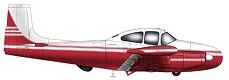
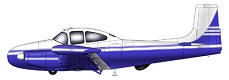
Camair's employees set to work improving the White's design. It would take until May 1955 before the Civil Aviation Authority (CAA)
would grant Camair its type certificate. I would be known as the Camair 480 (from the horsepower rating of its two 240hp
Continental O-470-B engines).
With a sale price of $39,000 the Camair 480 was more than 50% more expensive than the twins being sold by TEMCO-Riley. Instead the
heavier and faster Camair's main competition was the Cessna 310. Its top speed had increased to 220 mph, with a cruise speed equal
to the single Navion's top speed of 190 mph. Range was 900 miles and the maximum takeoff weight rose to 4,323 lbs. Between 1955
and 1959 Camair built 25 examples of the 480. Deterred by poor sales the rights were sold to Bill Taylor.
Taylor in turn took the Camair's production to a new facility in New Kingston, Pennsylvania and built three more 480s. Taylor moved
again, this time to Melborne, Florida. Several aerodynamic modifications and the installation of fuel injected IO-470-D engines of
260hp were introduced in the Camair 480C and three more were built on demand before 1969. Like the single Navion, the introduction
of a new model resulted in the rebranding of older aircraft. The Camair 480s suddenly became 480Bs. When Taylor's company became
more involved with the growing US space industry the company was sold to Fred Garcia.
Garcia took his materials north to New York State, where he completed the last two Camairs. Among his attempts to improve the
Camair design, Garcia installed a series of fairings, cosmetic improvements and single piece windshields. For a brief time, Garcia
installed 300hp IO-520 engines and three-blade propellers as the prototype for the 480D, but his plane N6900C (1-083) quickly
reverted back to its original 480C configuration. A total of 33 Camairs (and one WE-1) had been built.
Interestingly, in 1961 the government of Argentina was encouraging foreign companies to begin construction of aircraft by offering
financial support. Camair Argentina Sociedad An?nima was established in late 1961 and a single Camair 480C was converted and flown to
the South American country. Although it would fly there for the next 10 years, Camair Argentina couldn't manage to secure a single
sale. Arrangements had been made to use Aerotalleres Bahia Blanca S.R.L.'s facilities to perform any conversions, but a lack of sales
and financial mismanagement finally shut down the Argentina company by the end of 1967.