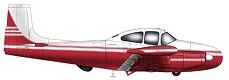
The home of everything related to Twin Navion and Camair aircraft
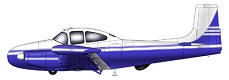

Airborne, the Camair shows how attractive it can be.
Photo courtesy of Trevor McTavish
It may be surprising but with all my exposure to everything Navion I had never actually seen a Camair 'in the flesh.' Even when my father was attending Navion Society
conventions in the late 1970s Camair's were considered extremely rare. Almost 30 years later and they've become even more elusive. In fact, there's only one in all of
Canada. An email to the owner resulted in an invitation to come out to not only see, but to fly his plane. The only problem was that I'm in Alberta, and he's in Quebec -
1,900 miles away. Luckily I work for an airline and was able to make my way to Montreal with little trouble.
Roland found his Camair back in 1984. He wasn't looking for a Twin Navion, but C-GSYV (1-069) happened to be based at the local airport, and it
had just been repossessed by the bank. In need of a plane to fly to his winter home in Florida the Camair was a bargain. Cosmetically worn it was mechanically sound. Even
today 'SYV has had very little in the way of upgrades. The instrument panel remained basically stock. So did the plaid interior in shades of brown. At some point the
windows had been converted to flush, one piece units (one of most basic, and more popular mods). The biggest improvement occurred not too long ago, when the troublesome
Continental carburetors were replaced by fuel injection.
Today 'SYV is kept on a small grass strip outside the farming community of St. Michel, south of Montreal. Populated by Roland's Luscombe, a Cherokee and Cessna 172, the
Camair is by far the biggest plane on the field.
As I approached the plane for the first time I must admit that I felt myself having been deceived. Looking at pictures the Camair seems so much bigger than any other Navion.
Obviously that deception is caused entirely by photography. After all, you can't use a Navion for the base of your conversion and make it any bigger.
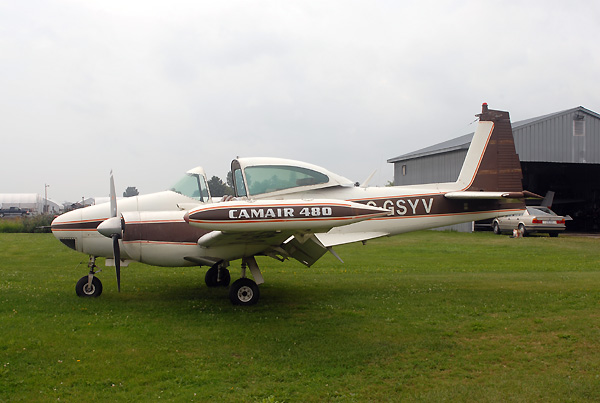
Unlike other Navions the Camair has a noticeable nose door stance.
Photo courtesy of Trevor McTavish
'SYV had an imposing stance; nose down, tail, high up in the air, almost like a wild animal preparing to charge. This is the normal stance for the Camair, and totally unlike
any other Navion. Part of the Camair conversion is clean, and quite attractive. I liked the nose baggage compartment which makes use of the space formerly filled by the
single's engine. Its size is perfect for bulky items, or for carrying up to 100 pounds. On the other hand, the aesthetically pleasing engine cowls barely open enough to see
the tops of the engine cylinders, let alone permit in-depth servicing. Roland's solution was to install removable hinge pins. The tip tanks, which come from the Fletcher
Aviation Corporation hold 34 gallons, but they look horrible. They were originally converted from napalm bombs and the weld seams, large access panels and external
reinforcements certainly don't improve their appearance. The large vertical stabilizer uses the single Navion's tail as a base, then adds a 13" plug and a fiberglass fin cap
to increase the area. A new rudder includes a trim tab.
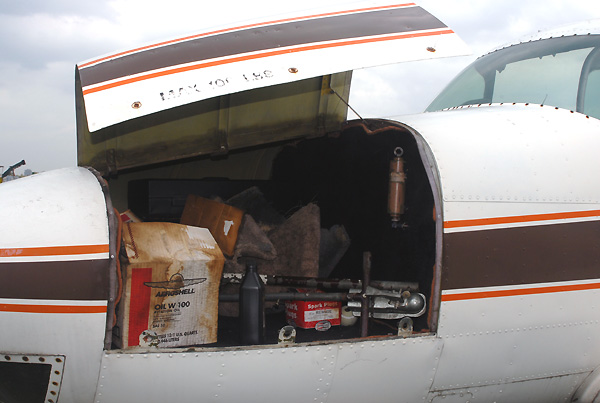
The nose compartment is quite large, and ideal for 100lbs of cargo.
Photo courtesy of Trevor McTavish
Boarding the Camair is done with the help of a step cut into the inboard flap. Leaving the hydraulic pressure off allows one to force the flaps down by hand. Heaven help
you if you forget to release the pressure - it's a long drop, or a limb stretching climb.
Getting into the front seats was easy in comparison to our TEMCO D-16A. Whereas our throttle quadrant prevents us from swinging our legs in from the side the Camair's is
tucked up underneath the instrument panel, making it smaller and less obtrusive. To prove this, just before my flight a local farmer climbed aboard for a quick aerial tour
of his fields. Unknowledgeable in the Navion's idiosyncrasies this 5' 10" individual had no problem getting seated. Pitch trim utilizes a wheel, much like the 'big planes.'
All of the switches, including the boost pumps and magnetos, are mounted above the front windshield. Although they weren't obtrusive they seemed perfectly located to hit
one's forehead.
Roland started the engines and performed the preflight checks, then warned me that directional control requires careful matching of the engines' rpm. With this in mind, I
slowly advanced the throttles and started rolling down the strip. There was little wind, and we were lightly loaded (two adult males and 30 gallons in the main tank). We
used up less than 1,000 feet of the field's 3,000 foot length. Had I been more aggressive I could have easily reduced our distance by 200 feet.
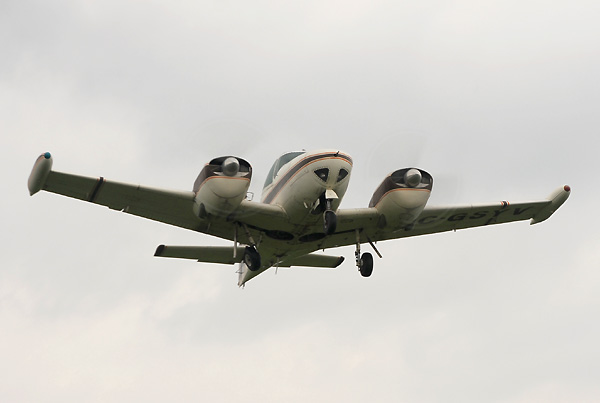
Lightly loaded the plane was off in a conservative 1,000 feet.
Photo courtesy of Trevor McTavish
I was surprised when Roland told me there were only two flap settings - full up, or full down. This certainly extended the takeoff roll and I'm not one for full flap
landings if I have enough runway.
Climbing out at 110 knots we quickly sped up to cruise at 160 knots, using 25 inches MP and 2,500 rpm. Although we didn't bother, some careful trimming and getting the plane
'on the step' and I'm sure we would have reached the advertised 190 knot never exceed speed. Roland was quite proud of his fuel injection system, and rightfully so. At
25-squared, we were burning 10 gallons per hour, per engine. At 23" and 2,200 rpm fuel burn dropped to 9 gallons, about the lowest Roland has gotten. In the Camair 480C
fuel injection and the IO-470-C engine produced an extra 20hp per side, there was no power increase in our case, but as Roland demonstrated, it makes for a much easier plane
to fly.
Without a headset I was able to get a good sense of how noisy the cabin really was. The exhaust's augmenter tubes produce a deep growl and the noise levels in the cabin were
much greater than those of a single Navion, Bonanza or our TEMCO.
Breaking from our smooth, stable cruise, I elected to try some steep turns and dutch-rolls. In both cases the plane yielded a solid 'big airplane' feel. Pitch and yaw were
similar to the other Navion's I've flown. The roll, which in a Navion is noticeably heavier than Piper, Beech or Cessna products, was heavier than the 225hp single Navion,
but lighter than our D-16A. Thinking back, this makes sense as the TEMCO carries an extra 32.5 gallons in each nacelle.
Next, we moved on to try some simulated single engine work. This is the test for multi-engine planes and I've always been curious of the Camair's stability when it came to
flying on one engine. Somehow the tail looks too small. We started by simulating a failure of the #2 engine. At zero thrust and 95 knots we were showing a 700 fpm decent
and no noticeable turn. Doing the same with #1 we had a 300 fpm decent and a slight, turn to the left. With rudder alone the turn was uncorrectable, and lowering the right
wing was needed.
Approaching the airstrip Roland took control for the landing. With full flaps and an 80 knot approach speed, he dragged the plane in to the end of the runway using a fair
amount of power. The wheels touched the grass at 70 knots and the Navion's beefy gear handled the rough surface quite well. With gentle braking we rolled to a stop in about
1,000 feet.
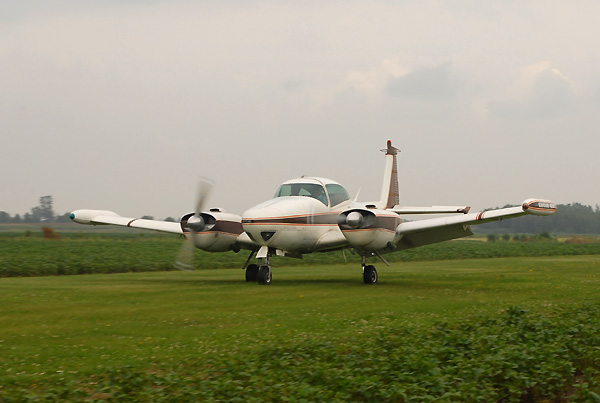
The Navion's beefy landing gear easily handled the grass field.
Photo courtesy of Trevor McTavish