The home of everything related to Twin Navion and Camair aircraft
There's an old saying, "when life gives to lemons, make lemonade." When work gave me a business trip to Seattle, WA, I hunted down the area's only Twin Navion. With a simple
telephone call I was able to arrange an afternoon meeting with Francisco 'Frank' Ochoa at the Arlington Airport.
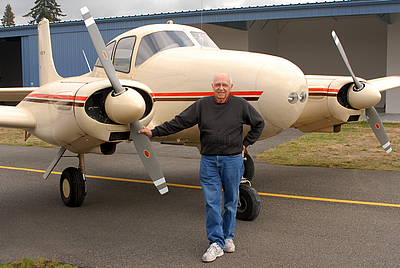
Frank Ochoa poses with his much improved D-16 during a September 2007 visit.
Photo courtesy of Trevor McTavish
Now retired, Frank had been employed for years as an aeronautical engineer with the Boeing Company. He'd been employed on structures, systems and aerodynamics on the B-47, 707,
B-52, 727, 747 and B-2. One of his fond memories was installing various instruments and sensors inside a B-52 Stratofortress before climbing to 50,000 feet and dropping dummy
nuclear bombs.
Years ago a friend of his owned a Twin Navion which Frank was able to use. But when he decided to sell Frank was left without an airplane. He found another Twin Navion, a D-16
(TN-4), in Ohio. Since he bought N107N back in March 1972 Frank and his family have enjoyed flying throughout the Western
United States.
Being an engineer Frank naturally looks at how things are built and tries to improve on them. N107N has been no different. As we walked around his Navion, Frank was quick to point out many of the improvements he'd designed, built and approved - all on his own.
- On the nose the air scoops for the cabin and heater inlet air have been replaced with flush NACA scoops made from fiberglass.
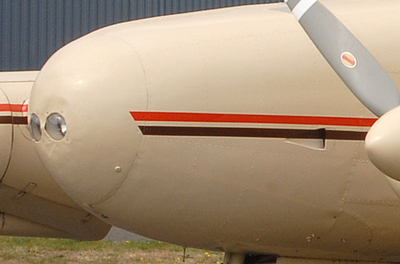
The original air scoop has been replaced by an NACA inlet.
Photo courtesy of Trevor McTavish - The inboard wing leading edges (D-cells) have been replaced with parts rolled from thicker aluminum. This permits the use of countersunk screws instead of the numerous large
protruding head screws originally installed.
- Frank has opted to have the ailerons balanced using the same technique as those Navions with the Osbourne tip tanks. Lead weights are screwed to the leading edges instead of
keeping the original, bulbous balance weights. On D-16As, where the tip tanks were installed at the factory, the balance weights are mounted inside the leading edge.
- Removed the boarding step behind the wing. This means the still nimble Frank has to stretch to climb up onto the wing. As he said, "I put it back when I'm taking a lady along."
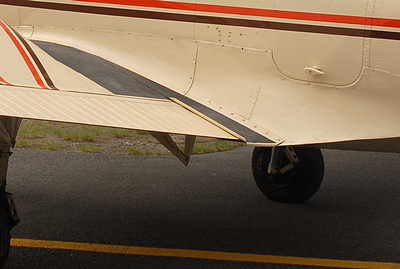
The removed step yields about 2mph.
Photo courtesy of Trevor McTavish - Frank was quite proud of the extended elevator trim tabs he'd designed and installed. He enjoyed boasting that he could land using nothing but his trim tabs. They sure looked
nice. It really surprised me, because I thought almost all Navions had been modified with Palo Alto angle of incidence change, but apparently not. Had the tail been modified, the
trim tabs would have had a 2 inch sheet metal extension added. This sent me back to look at all the photos I have of Twin Navion tails, and I haven't seen one with the modified
Palo Alto trim tabs. I guess you learn something new every time.
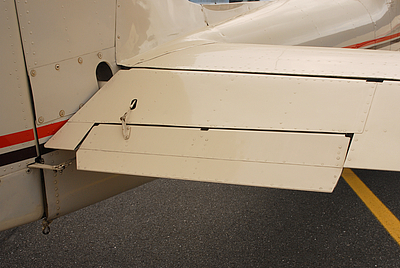
A close up view of one of the extended elevator trim tabs.
Photo courtesy of Trevor McTavish
Inside the cabin Frank pointed out the pilot's seats. The originals interfered with the rudder trim wheel, so he cut the seats in half, removed a section then reattached the sides.
Now Frank has lots of room, and access to the quadrant and trim wheel.
When I asked if Frank would be willing to share his any of his 337 forms, he told me he's always willing to let others look at what he's done.
Naturally cleaning up the Navion is not Frank's ultimate goal. For years he's been building a single-engine pusher in the hangar next-door. Powered by a 435 cubic inch engine
Frank's plane is a lesson in aerodynamics that borrows heavily from Boeing's military and commercial jets. 100 gallons of fuel should be enough to fly from Los Angeles to Hawaii,
provided Frank wants to stay airborne for 10 hours.
Aerodynamic refinement means butt-joints in the skins, flush rivets, countersunk screws, even custom made fuel caps.
To save weight the plane uses bicycle landing gear (like a B-47 or B-52), stabilized by small outriggers. Using leading edge and trailing edge flaps should give an airspeed envelop
from 40 - 50mph to as much as 650mph, should Frank manage to buy a small jet engine.
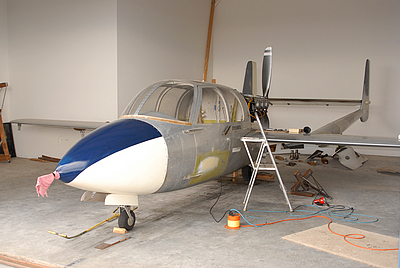
Frank's other project - a super fast, aerodynamically clean homebuilt.
Photo courtesy of Trevor McTavish