
The home of everything related to Twin Navion and Camair aircraft
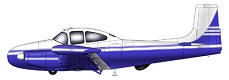
Imagine being asked to help ferry a friend's new airplane. You're excited, you're nervous, and you still have to get it home. Now imagine it is a vintage airplane built back
when Eisenhower was President, and "home" is some 4,200 nautical miles away, with long stretches of sea and jungle to be over flown.
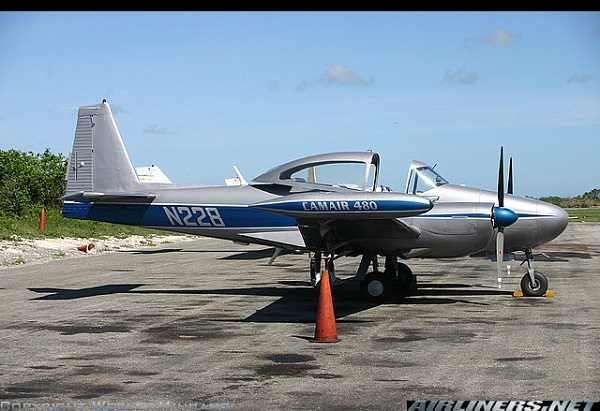
That's exactly the situation two Brazilian pilots went through when they flew Camair N228 (1-065) from Florida to Brazil.
And if you thought avgas prices were high where you are, in Macapa, they were paying R$ 4,95/liter, or about US$ 18/gallon.
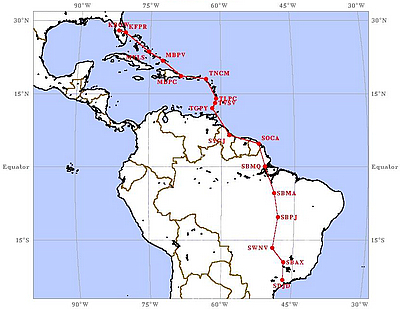
A general view of the route taken to Brazil.
Photo courtesy of Landings.com
The Route:
(2.5 hrs, 362 NM)
(1.4 hrs, 199 NM)
Ft. Pierce - Stella Maris, Bahamas
Stella Maris - Provo, Turks & Caicos
(2.2 hrs, 302 NM)
Punta Cana - St. Marteen, Netherland Antilles
(0.5 hr, 54 NM)
(0.7 hr, 76 NM)
Castries - St. Vincent
St. Vincent - St Georges, Grenada
(2.3 hrs, 295 NM)
Rochambeau - Macapa, Brazil
(2.3 hrs, 383 NM)
(1.2 hrs, 222 NM)
Palmas - Goiania, Brazil
Goiania - Araxa, Brazil
A brief (and very simplified) note about pressure carburetors:
A pressure carburetor is a complex unit that senses the difference between venture and ram air pressure and automatically makes adjustments in the fuel/air mixture.
Simply explained, it acts like a single point fuel injection system.
To provide pressure in the pressure carburetor, it's designed to pull more fuel than is required. The surplus fuel is then returned back into the tank.
So when you have multiple fuel tanks (three of them in a Camair), one has to burn off fuel from the main tank to make room before switching to the auxiliary tanks.
The surplus fuel from the tip tanks will gradually refill the main tank. Eventually you switch back to this tank and consume the rest of the fuel. Switching tanks too
soon will result in having your surplus fuel wastefully (and dangerously) forced overboard.
Oct 17th, 2007
Yesterday at Bartow we check flew N228 for the first time. We met 'Sharkey,' a man instructed by the previous owner to show us the plane and tell us her secrets.
We bought some supplies, oil, two life preservers, and tried the Camair for the first time. First Reis then me. That was the first time I flew a twin and Reis was a great
instructor. I've flown the other Navions belonging to the Camair's new owner; Navion E
(PT-AUR) and
Rangemaster H (PT-MJP) with him before the trip to familiarize myself
with Navion flying, but N228 was totally different. We were both getting familiar very fast with this new (to us) plane. She's both powerful and solid. A delight to fly, but
then again, OK, I must confess I've always been a Navion fan since I was a kid.
The plane was refueled yesterday and left at Bartow's main apron. Early in the morning the trip began. The Bartow - Fort Pierce leg was uneventful and we had breakfast at Ft. Pierce,
before taking to the air over the first big stretch of water, all the way to Stella Maris, Bahamas. Then to Providenciales, Turks & Caicos.
We refueled in Stella Maris, where the airport is usually flooded with rainwater. To go through immigration one has to take the shoes off and step into the water.
There we found we've lost part of a spinner, probably due to metal fatigue. I decided we could take the rest of the spinner off and fly without it for the rest of the trip, so we
did. After all, there are lots of Navions flying without spinners, so why not? The funny thing is that it seems that the engine's temperatures are now running lower, but this could
just be my impression.
The rest of the flight to Provo, was flawless.
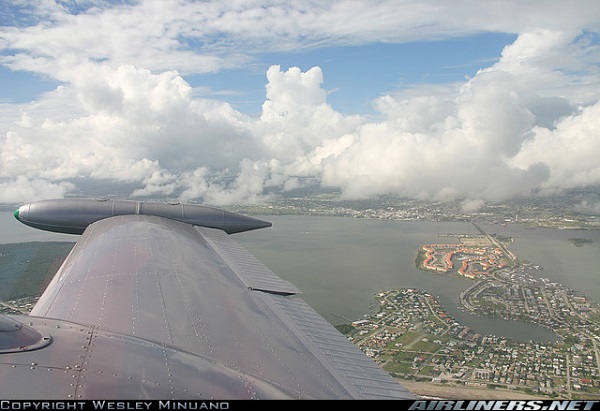
Airborne out of Florida and heading south.
Photo courtesy of Wesley Minuano via Airliners.net
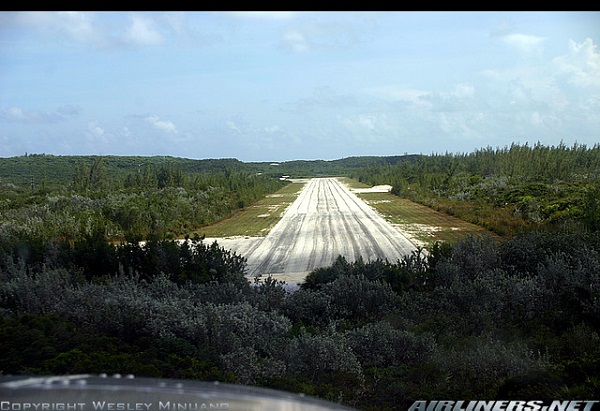
Final approach to Stella Maris International airport in the Bahamas.
Photo courtesy of Wesley Minuano via Airliners.net
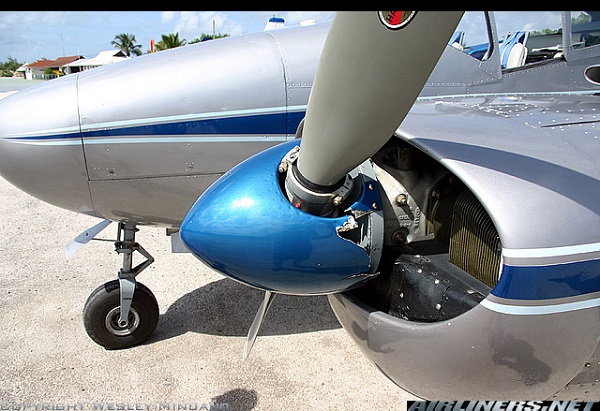
In the Bahamas, they discovered the spinner was disintigrating.
Photo courtesy of Wesley Minuano via Airliners.net
Oct 18th, 2007
Its true that the aircraft is old (rebuilt as a Camair in 1956), and that yesterday we lost part of her over the Bahamas. But its in generally good shape. Its also true there are
some oil leaks (it seems to just be throwing out the oil excess, and the engine is still breaking in, so we prefer to use full oil quantity). The landing gear lever also seems very
hard to operate and a bit out of reach for the pilot - usually requiring both hands to operate. Mixture levers work the opposite way to what we're used to, rich is down, lean is up.
Compared to my Turbo Arrow IV the Camair is slower, drinks avgas heavily, and doesn't fly high as high because of its normally aspirated engines. On the other hand, this is a solid
plane, built like an army tank. It flies great, its docile, and definitely is a head turner wherever you land. To that point the Fort Pierce tower interrupted radio communications
to ask what kind of airplane was that, what her story was, where we were going to, and in the end, to congratulate us for flying such a rare bird in such great shape. I think in the
end, we'll make it "alive and kicking" to Brazil.
Today, we experienced our first taste of corrupt government officials. Officers in Punta Cana took US$ 100 because, "life is hard."
Then, as we approached St. Marteen we were 'below bingo,' low on fuel, but we had to perform two 360-degree turns to allow faster traffic to land before us.
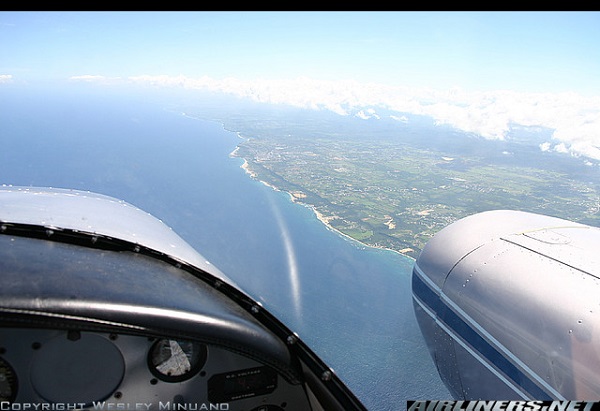
Passing Puerto Rico.
Photo courtesy of Wesley Minuano via Airliners.net
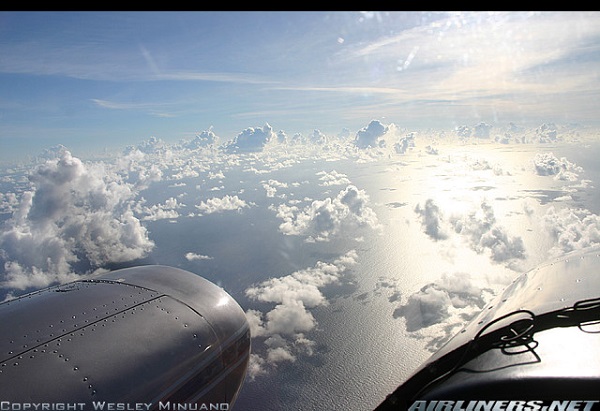
Approaching the Dominican Republic.
Photo courtesy of Wesley Minuano via Airliners.net
Punta Cana, Dominican Republic.
Photo courtesy of Wesley Minuano via Airliners.net
Oct 19th, 2007
Today we're Georgetown, Grenada. Going thru immigration in all these countries has been a real pain-in-the-ass, especially in St. Marteen. It is amazing, it seems they do not like
tourists there.
We landed in St. Lucia, because we were told there was avgas available. It turned out there wasn't, so we were forced to continue on to St. Vincent, flying over water with very
little fuel.
The airplane is quite good and easy to fly but has lots of details that require extra attention. For example, the fuel gauges are not accurate. We thought we had 10 gallons in the
main tank, the one we were using during the landing procedure in St. Vincent, instead of the tip tanks we used while level flying, and 10 gallons was the gauge's indication. As we
refueled, we learned that we only had 3 gallons, which would suffice for 6 minutes flying (more or less). In other words, had we needed to go around, we could possibly have had a
fuel starvation situation, even though there was lots of fuel in the tip tanks. In any case, it wouldn't have been possible to go around there because as with most of the islands,
runways are one-way because of topography on the other end.
Most islands have good runways, but many do not have avgas.
But we are getting familiar with the Camair and Reis has now more than 43 years of professional aviation and 90 ferry flights in his resume. He knows it all. Tomorrow we plan to
sleep in Rochambeau, French Guyana.
Oct 20th, 2007
We're presently in Georgetown, Guyana. The place is curious: it is India, mixed with Africa, inside South America. Taxis play loud Hindi music (the majority of the population came
from India). Poverty is amazing. Cows crowd the streets, as if we were in India.
We arrived here direct from Grenada. It was a 2:45 hr flight, me as pilot-in-command, Reis as "pilot-in-sleep." Now that we're familiar with the plane we can do this sort of crew
coordination.
Instrument meteorological conditions prevailed for almost one hour, flying inside clouds and light rain at 9,500 feet. First over the sea and then over the jungle.
The Camair's operation is critical in the longer legs because one has to closely monitor the fuel reserves. Maximum endurance is around 4 hours, probably 4:15 using the tanks to
their maximum. You fly one hour on the 40 US gal main tank, switch to the 34 US gal each tip tanks. But you have to plan this in advance, and leave some 15 gallons in the main tank
because fuel returns to the main tank, and it slowly starts to refill itself. If it is too full, you will throw gas overboard.
The fuel gauges are not reliable. The right tip tank gauge is inoperative and when the main tank indicates 15 gallons, it really has no more than 10. For the unadvised pilot, it
looks like it would be easy to run out of fuel even if you still have another hour's fuel in the tip tanks.
Endurance is critical for this kind of flight over water and jungle: we plan for a maximum of 4 hours. The legs we've been flying are an average of 3 hours, and we always plan with
1 hour reserve to deviate from eventual CBs along our way, or for other emergencies. When possible we fly in IMC so that we don't deviate from the planned route. Thus, operation
seems always on the edge of the envelope. To make this very same trip with less stress, my turbo Arrow's 5+ hour endurance would be so welcome.
Fuel flow varies between 28 and 30 gph, which is high, but we have to consider we're breaking the engines in. EGT and CHT gauges seem also unreliable and the Shadin Fuel Flow system
is not installed. On the other hand, the engines are performing flawlessly, as is the plane in general, considering her 50+ years of existence.
Usually we fly FL095, with a planned GS of 140 knots.
Seats are military style, and uncomfortable for this sort of long range flight, especially the copilot's. There is a price my back will pay by the end of the journey.
The cockpit's visibility is fantastic. Sometimes I feel that I'd like some curtains. What a great plane, they're not built like this anymore. And what's there to say about the
adventure? There have been a lot of experiences in this trip, especially for a first time ferry pilot like me. Then there's the fact that this is the first time that I've been in
command of a twin. And what a classic twin.
But back to Guyana. We landed, went to the AIS room for the weather forecast and flight planning, did the immigration chores, and paid lots of taxes. Our plan was to move on to
Rochambeau (French Guyana), as Reis says it offers some better infrastructure than Georgetown. By the way, this is also Reis' first time here in Guyana.
The reception was the warmest so far, but this is probably the poorest country visited in this trip, which is sad to see. The abandoned and untidy Beach Airways C-47A (9Y-TDY) says
it all. The airport (read runway) is good.
Then we had to start the engines to move from the main apron, and go to the refueling apron, close to a stationary fuel pump, there's no fuel truck that comes to your plane. That was
when the right prop feathered. It took us almost an hour to put the prop blades back in place and we used the help of two local airport officers. Eight hands finally did it. Sort of
Charles Lindbergh stuff.
Reis taxied N228 to the refueling apron. Refueling has to be done slowly and patiently. The fuel tank cap is narrow and if done quickly you may think the tank is full when it is
not. I personally supervise the refueling operation closely every time, and I'm the only one who closes the caps. Nobody else is allowed to touch the fuel tanks. The same goes to the
engine cowlings, which I've learned the ropes on how to open and close quickly.
Fuel drains (5 of them) also require some sort of flexibility to reach. One of them always gives you an avgas bath before you finally check for water and dirt. The fuel drains,
are also handled with extra care.
We are also began preparing a maintenance report. It seems to me that this plane hasn't been flown much, and because of that, it has some minor quirks to repair. All in all, the
plane is reliable, and Sharkey was 100% right when he answered my question if he would fly this plane "as-is" to Brazil: yes, he certainly would.
After refueling, we started the left engine first and when it came to the right it simply wouldn't start. We shut down the left engine and preferred to pass a DLA message and
cancelled the Macapa attempt. Rochambeau would suffice.
We preferred not to force the starter as having to deal with an electrician here in Guyana seems rather risky. So we waited another hour, and tried again, to no avail.
One hour later, after canceling our flight plan, the same thing happened to the left engine. Unbelievable! We gave up the idea of taking off, as it rains heavily in the afternoon
and we would have arrived in Rochambeau at night, which is not a good idea because neither Reis nor I has any night experience in this plane. We aren't even sure the instruments have
been properly calibrated, or that the panel lights will work properly, so doing an IFR procedure is out of question.
We took a taxi at the airport, with a Hindi driver. There's no decent hotel close to the airport so he took us to the Radisson, which is small and looks like something out of India,
but it was a nice move. The air conditioning wasn't strong enough to deal with the heat, and it really is humid. But the hotel has wireless network and the owner, who came from New
Jersey, is such a character.
On our way to the hotel (45 minutes from the airport), the taxi driver decided he would buy us a beer. He took us to a local bar, that looked more like a night club, though it was
around lunch time. But that was fun.
The hotels close to the airport cost around US$ 20 per night and we were told they could be dangerous. The one we're at, costs US$ 70, and the taxi has cost us US$ 40 each way.
Poverty is everywhere here. But, from the whole journey, this has been the place we've been most welcomed. Quite a difference from the arrogance of St. Marteens.
We expect tomorrow morning that we'll be able to start both cold engines, move on to Rochambeau, refuel, and then all the way to Macapa, Brazil.
Ah, one last curiosity: there seems to be a clandestine spider aboard, being imported from the US to Brazil. Every morning there is a new spider web on the nose gear. We saw that in
Bartow, but we believed the plane hadn't flown for a while.
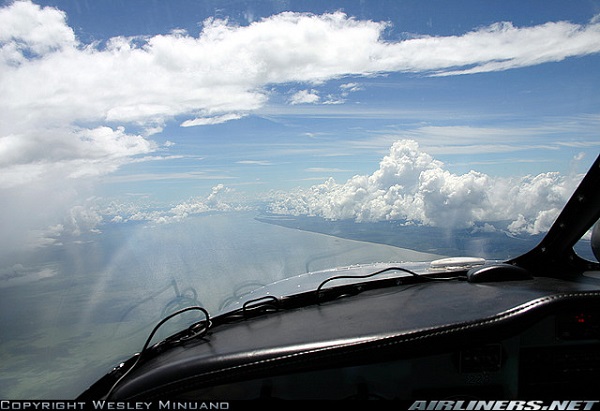
Over Guyana.
Photo courtesy of Wesley Minuano via Airliners.net
Oct 21st, 2007
Today's flight was from Georgetown, Guyana, to Rochambeau, French Guyana, where we refueled, and then from Rochambeau over Zandery, Paramaribo, all the way to Macapa, Brazil.
Starting the engines in Georgetown proved to be the same stress, with the right engine refusing to start. On the third attempt, Reis found out that keeping the primer pressed the
engine would start, although roughly. Keeping the primer pressed for a while, at higher RPM, fuel flow would stabilize. There must be a problem with the fuel system, but we feel we
can move on. Otherwise we would be grounded here until we got proper help, and this would take days or weeks.
It was good to spend the night in Guyana, even if we had to navigate through all the difficulties. Fact is we were conservative on the starter, and this allowed us to continue the
trip. If we lost the starters our flight would have ended in Guyana. If fuel flow flutters, and if we need to keep the electric fuel pump on, we'll land and interrupt the flight.
We had a cup of coffee in Georgetown and called it breakfast. The AIS room in Georgetown International Airport (Cheddi Jagan / Timehri) was some 15 minutes walk away at the tower.
You can't reach the AIS room from the apron, and because of this, you have to pass through immigration 2 to 4 times. Such stupidity.
Engines started, fuel flow checked and stable, we decided to press ahead.
We reached Rochambeau, French Guyana after a more than 2 hours flying. The coffee shop here is behind immigration, so we couldn't eat, plus we were on a tight schedule. The AIS room
and weather forecasting is European style - superb.
Once we cross Oiapoque, the border between French Guyama and Brazil, problems started:
- there were lots of wildfires in the Amazon jungle.
- none of the Brazilian navaids were working.
- the Amazon Control does not have a decent radio system, and commercial flights (GOL/TAM/VARIG) have to help relaying messages between aircraft and ground stations, even to Brazilian Air Force aircraft and Army helicopters - such a shame.
- The VOR at Macapa is inoperative.
- Macapa tower frequency is also inoperative and you only talk to Macapa approach, and that only has a 50 NM range.
In Georgetown, Guyana, we refueled the plane for US$ 400, here in Brazil we paid almost US$ 800 for the same amount of avgas. This, even with the low USD rate, is so strange.
ANAC, the Brazilian version of the "we're not happy until you are not happy" American FAA, requires an extra dose of patience. They ask you for lots of documents, and they are true
Latin American "authorities." But when it comes time to print the necessary forms, they will tell you the printer's cartridge has run out of ink and that they don't have a spare.
The Health Authority said Guyana is a high epidemic area, but he didn't require any vaccination certificates. Instead, he limited his work to asking if somebody has sprayed the
aircraft.
The Federal Police didn't worry about searching our bags, after all, ours was an international flight and we could have been bad guys.
The guy from the Receita Federal, a Brazilian version of the IRS (because the plane was being imported to Brazil), was not at the airport. Ok, it was Sunday, but then again, it is
an international airport with international flights.
We were told by the ANAC lady that without the Receita Fedral form she couldn't clear plane. She also told us that her office before 1800. She sent us back to the Receita Federal
office, where the man still hadn't shown up. She also informed us that the ANAC office would only be open the following day (a Monday) from 1200 to 1800. Even if we succeed in
obtaining the Receita Federal forms, we'll still have to wait. Tomorrow we'll try to go to Receita Federal's downtown office, because the officer doesn't show up at the airport in
the mornings.
Speaking of forms, that same lady couldn't print the ANAC forms because of an "ink shortage." Instead, she offered to hand write a document, and it should be as good as a printed
one. We helped her obtain an ink cartridge at a nearby air taxi office - unbelievable.
You would expect the ANAC, Receita Federal, and Federal Police offices to be open 24 hours a day at such an important international airport, close to the Brazilian border, but things
don't always go as one would expect.
Bottomline - when we left the Macapa airport, the chance of taking off the following day was quite small. Our plan of reaching Palmas or Goiania was scrapped. If we reach Maraba
we'll be happy. There's just too much bureaucracy.
Costs - this flight has cost almost twice as much as flying a similar Piper Seneca V. We need twice as many landings, hence twice as many fees. Fuel consumption is almost 30% higher
and we fly at 75% of the Seneca's cruise speed.
On the other hand, the plane is solid and reliable, and I wouldn't trade flying the Camair for a similar trip in a Seneca or Baron.
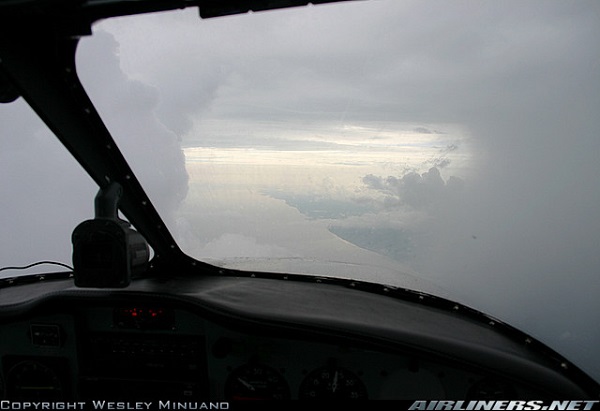
Encountering rains between Georgetown, Guyana and Cayenne, French Guiana.
Photo courtesy of Wesley Minuano via Airliners.net
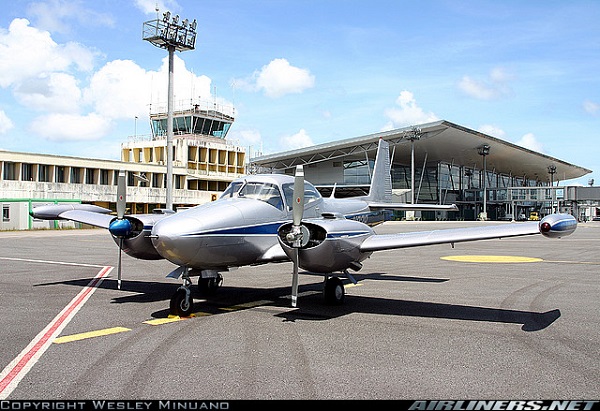
On the ramp in French Guiana. Notice the missing spinner.
Photo courtesy of Wesley Minuano via Airliners.net
Oct 22nd, 2007
We finally managed to finish all of our bureaucratic chores in Macapa. It took us all morning, only because we started at 0700.
The weather forecast was not very favourable, but we decided to escape from Macapa and flew direct to Maraba over the Tucurui reservoir. Tucurui would be our alternate. Most of the
flight was in IMC on top, eventually becoming real IFR as we landed in Maraba, under rain and low overcast. Not the best conditions for a plane where we weren't sure about the
accuracy of the instruments.
We reached Maraba late enough to cancel our plan of reaching Palmas today. The poor weather wouldn't have helped anyway.
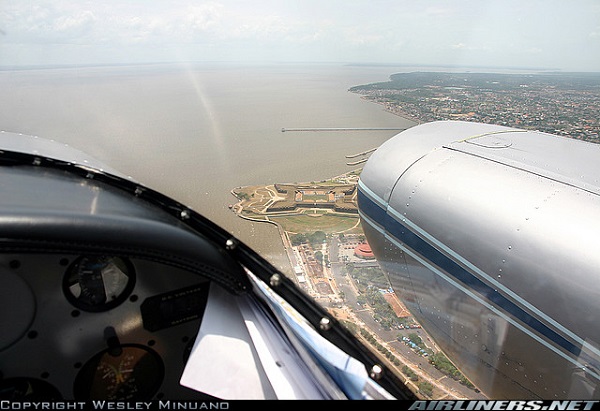
Flying between Macapa and Maraba, Brazil.
Photo courtesy of Wesley Minuano via Airliners.net
Oct 23rd, 2007
Aviator's day in Brazil!
And what a better day to get our 'speeding ticket' than with a 202 knot groundspeed! Of course, this was due to a 50+ knot tailwind.
We left the hotel in Maraba very early in the morning with no time for breakfast. It took more than 2 hours of waiting before the weather conditions allowed our flight. A GOL Boeing
737 tried to land four times, but conditions were below minimums, and there's no ILS, they finally had to divert. Locals say the clouds 'glue themselves' to ground in the morning, so
high is the tropical humidity because of the Amazon forest.
We flew IFR on top from Maraba to Palmas, and then after refueling, Palmas to Goiania with that 50+ knot tailwind, allowing us to reach Araxa while there was still daylight. During
the Goiania to Araxa leg both GPSs had no signal for about 20 minutes, but as we were always flying with traditional navaids (NDBs, VORs, and an unfolded chart on our laps), it
wasn't a major issue.
Flying in northern Brazil was made very interesting because of the local pilots; some of them probably don't even have certificates. We observed this on the coordination frequency
(123.45 MHz), where a discussion was taking place about a pirated Windows XP installation, or know how many cows the plane's owner has sold and for how much. No one used their tail
numbers, instead they called each other by nicknames. Monitoring that frequency, which is mandatory when VFR flying in Brazil these days, can become really boring, there's so much
useless chit-chat that you have to listen to. Then you have the jungle down there. If there was ever an emergency, you couldn't tell anyone because there was never a break in the
talking. Reis lost his nerve at one point and politely asked the other 'pilots' to change the chit-chat frequency. Why not 123.00 for example? What for? He was called names, and
even threatened with death should the other pilot meet him somewhere. Unbelievable. It looks like we're back in the old, wild west.
Tomorrow we plan to fly the Araxa - Marte leg. We should arrive by noon. It will be the first chance for a decent breakfast in 9 days. Ferry pilots have a hard life.
Oct 24th, 2007
Marte was closed due to weather. We arrived under IMC at Jundiai at 1100. If the weather helps, we'll still try to fly the last leg, otherwise we'll take a taxi and come back
tomorrow to pick up the plane.
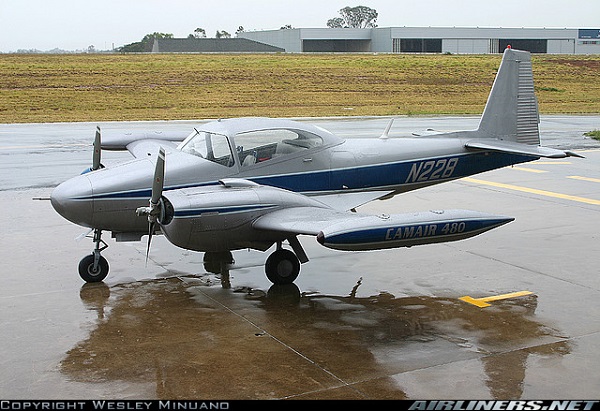
Success! On the ground in Jundiai, Brazil.
Photo courtesy of Wesley Minuano via Airliners.net
Wesley Minuano sent us a fantastic collection of photos, which make up the entire ferry flight of N228. Rather than repost more than 300 pictures, visit
his whole photo collection