The home of everything related to Twin Navion and Camair aircraft
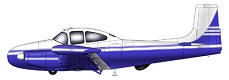
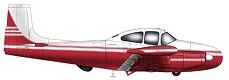
Download three-view drawings of D-16 Twin Navions. Click here and here.
Jack Riley, one of the top aircraft salesmen in the United States secured the production rights to the Twin Navion and began
production in the second half of 1952. 17 examples of the D-16 were converted by Riley Aircraft before production
transferred to Texas based TEMCO Aircraft Corp. The first examples were equipped with 125 horsepower Lycoming O-290-D
engines taken from a Piper PA-20 Pacer. These were replaced by 135 horsepower O-290-D2 engines at the beginning of 1953.
Each of the early D-16s was an individualized conversion. Planes were equipped with the customer's choice of options,
avionics, and exterior paint. Major changes involved reshaping the nose cone to a blunter shape, and installing a fuel dump
system for the auxiliary fuel tanks in the baggage compartment. After production started the original Sensenich Skyblade
variable pitch propeller was replaced by a similar Aeromatic propeller. In early 1953 both were replaced by a fully
feathering, constant speed propeller manufactured by Hartzell.
Unable to meet demand for its new light twin, Riley Aircraft was forced to outsource production, and in early 1953 an
agreement was reached with Texas-based TEMCO. Within weeks, TEMCO purchased the type certificate and became the owner of
the D-16. Riley in the mean time maintained the task of marketing the Twin Navion.
The most important change introduced by TEMCO was the use of mass-production manufacturing techniques. Each Riley-built
D-16 was basically a hand-formed plane, which greatly complicated assembly of the nose cone and engine nacelles. TEMCO's
solution was to use pressed components in the nose cone. This reduced the parts and labor required, but also reduced the
size of the baggage compartment's opening. The changes were significant enough that a type certificate was issued. D-16s
modified by Riley Aircraft were distinguished by a serial number starting with TN (for Twin Navion), while TEMCO examples
were TTN (TEMCO Twin Navion).
Many of the early D-16s returned to the TEMCO factory to have many of the upgrades, most commonly, having O-320 engines
installed, or the Riley nose replaced with a TEMCO assembly.
135 hp at 2,600rpm
180 lbs (rear)
- Serial numbers TN-1 thru TN-17 and TTN-1 thru TTN-15 were eligible to be upgraded to TEMCO-Riley D-16 standards. Note that serial numbers TN-1, TN-2 and TN-3 were never officially assigned. Those planes retained their single Navion serial numbers.
180 lbs (rear)
- All D-16s were eligible to be upgraded to TEMCO-Riley D-16A standards.