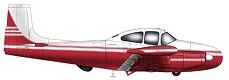
The home of everything related to Twin Navion and Camair aircraft
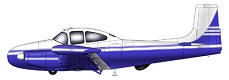
In 1947 the U.S. Army Field Forces and National Guard saw a need for a multi-purpose liaison plane. A competition was held
facing four-place aircraft against each other in the areas of reconnaissance, personnel and cargo carrying, light
transportation, courier service, general communications assignments and utility work. In many of these cases the use of
multi-engine transports was considered uneconomical while the tube and fabric light planes in use during WW2 were too small.
By finding an off-the-shelf solution, the USAF was able to avoid many of the developmental and tooling costs associated with
new aircraft construction, and thereby circumvent the massive scale backs and budgetary reductions facing the military after
WW2. It was estimated by taking this approach cost one-third the price of developing a similar aircraft from scratch. It
also allowed the military to benefit from the thousands of flight hours accumulated by the civilian fleet.
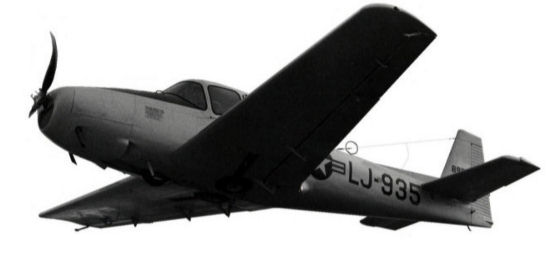
North American Aviation won the competition with their NAvion, and a contract for 83 examples was signed, giving the type
the military designation of L-17A. The robust construction and predicable flying characteristics were ideal for an airplane
intended to be flown by aging officers, while maintained by 19 year olds. The comfortable four-place interior made it a
welcome transport for officers, and with a removable rear seat, a 1,000 pound payload, and an RCA VHF radio, the NAvion
would quickly find more roles.
With the formation of the US Air Force in 1947, operation of all aircraft passed to the USAF, and it was this branch of the
military that procured the L-17 fleet, even though most would serve with the US Army. In August of 1948, after the
production rights had been sold to the Ryan Aeronautical Company, the USAF placed another order for 158 L-17s. The contract
also called for components and spare parts which were (dollar wise) equivalent to another 60 L-17s. Ryan-built L-17s
incorporated a small number of upgrades, including a 20 US-gallon underseat auxiliary fuel tank, bringing with it the
designation of L-17B.
35 L-17As returned to the USA to be upgraded to L-17B standards. This work was performed by the Schweitzer Aircraft
Company, and the planes were redesignated L-17Cs.
The L-17B fleet was assigned to Army Occupation Forces abroad, to the Army Field Forces in the USA, and to the National
Guard, each receiving approximately one-third of the aircraft. A large contingent of the L-17s in Europe were operated
under the Commander-In-Chief, European Command, in Germany. A similar group under the Far East Command in Japan were called
into service with the start of the Korean War.
Initially getting aircraft to the Korean combat theater proved a challenge. Two groups of L-17s were delivered to the
theater on the decks of the escort aircraft carriers USS Sicily (CVE-118) and USS Badoeng Strait (CVE-116), with the planes
being flown off the carrier deck upon their arrival. Both General Douglas MacArthur and General Matt Ridgeway had personal
L-17s. It was a quirk-of-fate that brought the L-17 into front line combat, when the pilots began using their factory-
equipped RCA VHF radios to act as a bridge between the soldiers on the ground and the armed combat aircraft above. With a
simple radio call, United Nations troops could call down air support from rocket and bomb equipped North American F-51D
Mustangs, and Lockheed F-80 Shooting Stars. The role was quickly called front line tactical air control, later forward air
control (or FAC), and planes were logging upwards of 100 hours each month. When armed air support wasn't available, L-17
pilots took it upon themselves to buzz enemy troops. In several cases North Korean and Chinese soldiers surrendered to the
intrepid fliers, obviously confusing the L-17 for its armed F-51 brother.
L-17s were also used by the Joint Brazilian-US Military Commission in Rio de Janeiro.
An additional five L-17Bs were purchased after the delivery of the original 158, and shipped to Greece for use in that
country.
An unknown number of L-17s were converted into pilotless, radio-controlled drones by the TEMCO Aircraft Corporation, under
the QL-17 designation.
As the L-17's service began coming to an end, most were returned to the continental USA and relegated to 'hack' duties
within numerous squadrons, ROTC (Reserve Officer' Training Corps) flight training, USAF Aero Clubs and with the Civil Air
Patrol (CAP).
In 1962, the USAF changed its designation system, eliminating the L for Liaison designator. Therefore all surviving L-17As,
Bs and Cs were redesignated as U-18As, Bs and Cs.
(engines s/n 5122 and greater eligible for one minute
205 hp at 2,500 rpm for takeoff only)
(engines s/n 5122 and greater eligible for one minute
205 hp at 2,500 rpm for takeoff only)