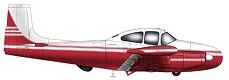
The home of everything related to Twin Navion and Camair aircraft
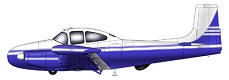
In the summer of 1945, J.H. "Dutch" Kindelberger, President of North American Aviation, and J.L. "Lee" Atwood, Vice
President, tasked Chief of Design, Edgar Schmued, with developing a modern light aircraft for the general aviation boom many
anticipated to follow with the declaration of peace.
There's speculation on whether North American Aviation was serious about entering the civilian market, one which NAA had no
pre-war experience with. Certainly the expected costs of production were far greater than the prices returning GIs would be
able to afford. The most accepted theory is that management at North American felt that keeping their experienced engineering,
design and production groups intact as they waited for a new series of military contracts for jet aircraft was well worth any
finacial loses that may be incurred with producing a light airplane. Regardless of the justifications, NAA allotted $7.5-million
to develop, test and certify the new plane.
Schmued assembled the same team that developed the famous Mustang fighter plane, and began fleshing out the design under the
NAA internal designation of NA-143.
The NA-143 was to match a comfortable four-seat cabin with modern, all-metal construction and gentle handling
characteristics. In addition, the plane was to be sturdy enough to permit off-field operations. Many of the NA-143's
physical traits were the direct result of the men fleshing out the design. They based much of the profile on their P-51D
Mustang, including the sliding canopy and the use of hydraulic landing gear and flaps. Like other NAA aircraft, the wing of
the NA-143 employed only a series of stub-spars, which spanned only between the main landing gears.
At the start of 1946, the NA-143 was finally given its identity. Someone suggested the use of the company's abbreviated
name (from the stock market). Suddenly the NAvion was born.
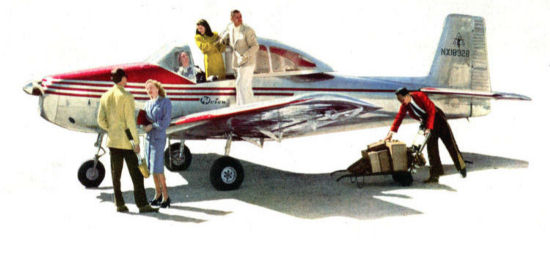
In February 1946, it was announced that the NA-143 prototype, NX18928, had been successfully tested and flown.
The NA-143 was intended to be a simple aircraft to design and produce, with aluminum skins measuring only sixteen to twenty
thousandths of an inch thick. Even the main landing gear legs were simplified, with only one casting being employed in the two
locations; one set of scissors pointed forward, the other backward. Anecdotes tell that shortly after the NA-143 had been
completed either the NAA materiel or accounting departments, or possibly both requested that the NA-143 be modified to
consume a surplus of wartime thirty-two thousandths thick aluminum stock. The beefier plane then received the new designation
of NA-145 NAvion.
Sometime after 1946, North American Aviation disposed of the NA-143 by selling it on the civil market. Its prototypical nature
and unique construction made it difficult (if not impossible) for the new owner to certify. It was last seen parked in a
remote corner of an airport in the Florida Keys in 1952 wearing a heavily weathered coat of maroon paint.