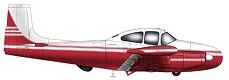
The home of everything related to Twin Navion and Camair aircraft
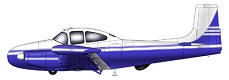
Download three-view drawings of the NAvion and Navion A. Click here and here.
Intended as to keep North American Aviation's engineering and manufacturing teams together during the brief period between the closure of P-51 Mustang production, and the
start of jet production, NAA decided to enter the civilian airplane market. Known internally as the NA-154, NAA allotted $7.5-million to develop, test and certify their new
plane. It was finally given its identity in 1946 when it was suggested to use the company's abbreviated name (from the stock market), suddenly the NAvion was born.
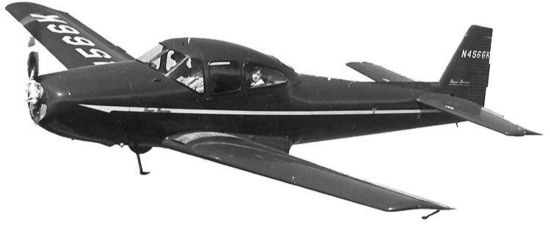
Debuted in February 1946 the NAvion was constructed entirely of metal and featuring retractable landing gear, making it one of the most modern aircraft on the postwar market.
Its rugged construction, docile handling characteristics and sliding canopy all became hallmarks of the type. Production lasted from mid-1946 to April 1947, during which
time hundreds of orders were placed, including one from the United States Air Force.
Initially selling for $6,100, production would occure in batches of 250. Shortly after production began, North American announced that they'd signed $7-million in sales.
NAvions quickly grew in popularity, with businessmen, State Police agencies and members of the Hollywood elite purchasing their own planes, which were now rolling off the Los
Angeles production line at a rate of 10 each day. But NAvions did have their draw backs. The heavy construction, high lift wing and low power of the Continental E-185
engine limited performance. The biggest limitation was the top speed, 12mph slower than the Beech 35 Bonanza. More importantly, North American was loosing money on each plane
they finished. Production costs were approximately $18,000 but even with 1947's price increase to $6,750 for a standard model and $7,750 for one with an IFR instrument panel,
North American management announced that NAvion production would cease on April 14, 1947. But with hundreds of NAvions filling the ramp in Los Angeles, no gaps in delieveries
occured.
In July 1947 ownership of NAvion passed from North American Aviation to Ryan Aeronautical Company through an $8-million sale. Production moved from Los Angeles to San Diego
and resumed with the only change being the use of a lower case 'a' in the Navion name. The first Ryan-built Navion, now selling for $7,750, was delivered in October 1947.
The following season saw the introduction of the first "Ryan Refinements" - options intended to increase the Navion's usefulness. These included improved instrumentation and
auxiliary fuel tanks. 1948 also saw the introduction of four high-gloss enamel paint finishes in maroon, blue, cream and green. Prices increased again in 1948, to $8,750 for
a standard model, jumping again to $8,990 before the year was out.
Dropping sales in 1949 reduced production to a rate of four each day, so Ryan slashed prices by $1,000 to $9,485 for the Utility 205 model, and $10,985 for the De
Luxe 205. The Utility 205 was a bare-bones workhorse aimed at those needing a flying pickup truck, while the option laden De Luxe 205 was aimed at the
business traveler.
Failing sales, demanding military contracts needed for the Korean War, and the uneconomical production cost forced Ryan to cease all Navion production in May 1951.
(engines s/n 5122 and greater eligible for one minute
205 hp at 2,500 rpm for takeoff only)